
WordPress
Your site. Your AWS account. Nobody else's hosting bill.
A production-ready WordPress deployment in your own AWS account in about 20 minutes — the platform powering over 40% of the web, configured the way an AWS consultancy would do it for a business that can't afford downtime.
Deploy on AWS Marketplace →High-Performance WordPress, Without the Managed-Host Markup
Small & Growing Businesses
A fast, reliable site without a managed-hosting markup.
Marketing Agencies
Manage multiple client sites without per-site platform fees.
Bloggers & Publishers
High-traffic content delivery you fully control.
E-Commerce (WooCommerce)
Database performance tuned for real transaction traffic.
SaaS Marketing Sites
Fast, cacheable pages without vendor lock-in.
Nonprofits
Production-grade WordPress hosting on a nonprofit budget.
If you're paying a managed host mostly for convenience rather than for anything WordPress itself can't do on its own, the next section shows what that convenience is actually costing you.
Managed WordPress Hosting vs. One Flat Cost
| WP Engine | Pantheon | WordPress VIP | This Pattern | |
|---|---|---|---|---|
| Price | $30/mo+ | $50/mo+ (Basic) | $2,000/mo+ | $0.02/hr flat (~$14.60/mo) |
| Pricing model | Per site, tiered | Per site, tiered | Per site, enterprise | Per organization |
| Billing | Monthly/annual | Monthly/annual | Annual contract | Usage-based, cancel anytime |
| Data lives on | WP Engine's servers | Pantheon's servers | WordPress VIP's servers | Your own AWS account |
| Cost as you grow | Escalates by tier and traffic | Scales to $500–916/mo at higher performance tiers | Enterprise-only, custom scaling | Stays flat |
Pricing shown reflects each provider's publicly listed entry tiers; feature sets, support levels, and included dev tooling differ meaningfully between them, so this compares hosting cost specifically, not full feature parity.
Enterprise-grade managed WordPress hosting like WordPress VIP commonly starts around $2,000/month — this pattern costs about $15/month flat, running the exact same open-source WordPress core.
Free, Open-Source Publishing Software
WordPress core has always been free and open source, powering over 40% of the web — managed hosts charge for convenience and often restrict plugin and theme choices along the way. Self-hosting keeps full control of those decisions.
Free & open-source, no license fees
No restricted plugin or theme choices
Site data stays in your infrastructure
No forced upgrade schedule
Production-Ready, Following AWS Best Practices
This CloudFormation template and custom AMI deploy a complete WordPress environment — live in about 20 minutes.
Auto-Scaling
Handle traffic spikes automatically.
Managed Backups
Automated database and file backups.
Custom Domains
Easy SSL certificate management.
High Performance
Optimized for speed.
What's Easy to Get Wrong, Handled By Default
Setting up EFS shared storage so uploads work correctly across multiple servers
EFS shared WordPress files, configured by default
Configuring SSL certificates and keeping them renewed
ACM-managed SSL certificates, renewed automatically
Setting up object caching that actually holds up under real traffic
ElastiCache object caching, tuned for production
Tuning a database cluster for content-heavy or e-commerce sites
Aurora MySQL cluster, sized for production
FOSSonCloud is built by Ordinary Experts, an AWS Consulting Partner working in Infrastructure as Code since 2014. This isn't a repackaged black-box AMI — the CloudFormation template is open source, so you can see exactly what's being deployed.
Architecture
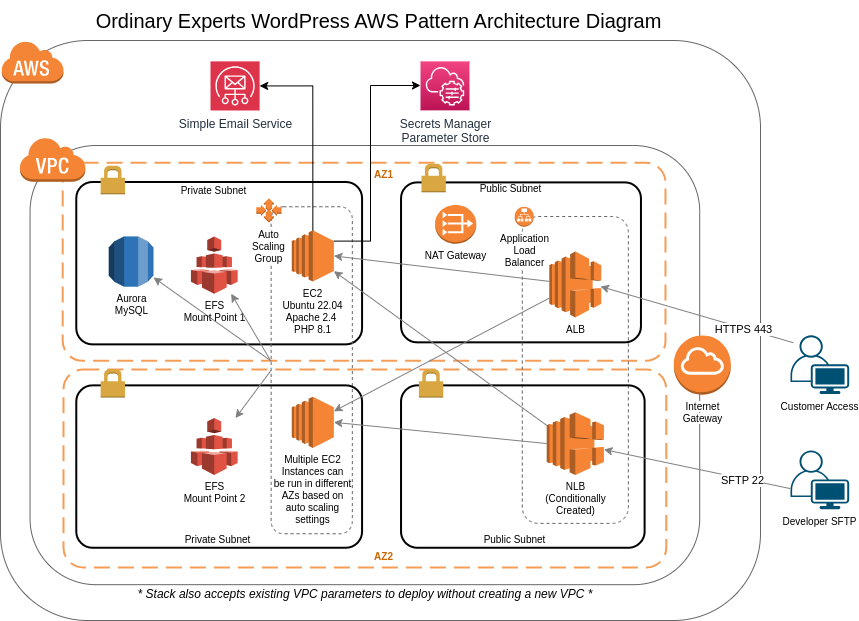
This pattern deploys a complete WordPress infrastructure including:
- Auto-scaling EC2 instances
- Aurora MySQL database cluster
- EFS for shared WordPress files
- ElastiCache for object caching
- CloudFront CDN
- ACM for SSL certificates
What You'll Need
Everything required to go from this page to a running WordPress deployment.
An AWS Account
With billing enabled and permission to launch resources in the region you plan to deploy to.
A Subscription to This Pattern on AWS Marketplace
Accepting the marketplace terms is what makes the CloudFormation template available to launch in your account.
A Registered Domain Name
Pointed at the infrastructure this pattern creates — used for your ACM-managed SSL certificate and site URL.
IAM Permissions to Launch CloudFormation Stacks
The stack creates auto-scaling EC2 instances, an Aurora MySQL cluster, EFS storage, ElastiCache, and a CloudFront distribution on your behalf.
About 20 Minutes
For the stack to finish launching before your WordPress site is live.
Up and Running in 4 Steps
Subscribe to the WordPress pattern on AWS Marketplace
Launch the CloudFormation stack in your AWS account
Complete the WordPress installation
Install your theme and plugins — live in about 20 minutes
Self-Hosted Doesn't Mean Unsupported
Free Onboarding Session
A 1-hour call with a FOSSonCloud engineer, included with every deployment.
Ongoing Email Support
Direct line to support@fossoncloud.com whenever you need it.
Fully Open Source
Deploy on AWS Marketplace
Production-ready WordPress in your own AWS account, live in about 20 minutes.
Deploy on AWS Marketplace →